Mostrando las entradas con la etiqueta mining investment in peru. Mostrar todas las entradas

viernes, 10 de enero de 2020

► Mining investment to continue increasing in 2020


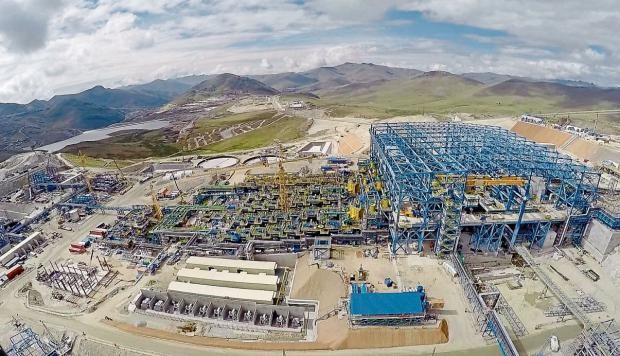
In 2019, investment in mining projects amounted to around US$6 billion. Of note were cooper projects such as Quellaveco (nearly US$1.2 billion accumulated in the last twelve months), Mina Justa (US$700 million) and Toromocho 1 (around US$400 million).

Within this context, BBVA Research estimated that mining investment is expected to continue increasing in 2020, although at a slower pace, with an annual growth of 9% compared to 18% recorded in 2019.

In the following years, the mining investment boost will be softened due to completion of new copper projects under implementation.

According to the study carried out by BBVA Research, the new copper units will reach maximum production levels by 2024. They are expected to produce 477,000 metric tons together.

Copper production is estimated to be around 3 million metric tons. Thus, Peru will remain the second-largest copper producer in the world.
Moreover, this scenario can be improved if the construction of awarded projects occurs first.
Said projects, which are in different stages of study, include Chancas, Yanacocha Sulfuros, Huquira, Zafranal, Coroccohuayco, and Magistral (copper); Pampa de Pongo (iron); San Gabriel and Inmaculada (gold); Pachapaqui (zinc); plus Corani (silver).
"All these projects represent a total investment of US$12.5 billion," the bank stated.

► Peruvian Mining investment to reach US$12.800 billion in 2020-2021

Antapaccay mine pite Lake
Peru's Energy and Mines Ministry (MEM) on Thursday projected the country will receive mining investments worth US$6.300 billion in 2020 and US$6.500 billion in 2021.

Thus, the upward trend —registered since 2017— will remain in place.

Deputy Minister of Mines Augusto Cauti informed that mining investment is close to reaching US$6.000 billion in 2019, thus ending the year with a growth rate of almost 25%.

"This year, we are growing at about 25% in mining sector investments compared to last year. We will reach three consecutive years of expansion, which is not a minor figure considering the global situation," he expressed.

Steady increase

It should be noted mining investment totaled US$3.928 billion in 2017, which meant a growth of 17.8% over 2016.

In 2018, mining investment amounted to US$4.947 billion, thus representing an expansion of 25.9% compared to 2017.

"This improvement is not only important for this sector, but also for the country since mining is one of the driving forces behind the country's growth and the population's development," the deputy minister underlined.

miércoles, 8 de enero de 2020

Cerro Verde, Antamina and Southern led copper production during 2019


The accumulated national copper production as of November 2019, registered an increase of 1.1% compared to a similar period of the previous year, thanks to the better performance of Compañía Minera Antamina SA (18.8%) and Southern Peru Copper Corporation with 16.9 % due to the implementation of the Toquepala Expansion project located in Tacna.

At the company level, Sociedad Minera Cerro Verde S.A.A. It remains first as the main producer representing 19.2% of the total, while Compañía Minera Antamina S.A. and Southern Peru Copper Corporation occupied the second and third positions with a participation of 18.8% and 16.9%, respectively.

At the regional level, Arequipa remains in first place representing 19.4%; while Áncash and Apurímac were in second and third place, concentrating 19.1% and 15.6%, respectively.

martes, 11 de junio de 2019

► MINING INVESTMENT IN PERU 🇵🇪

A PERSPECTIVE AS A COMMUNICATION SPECIALIST 


Communication is an important keyword in order to understand mining investment in Peru.

Still, there is a lack of investigations about the relation between communication management of focused messages and mining sustainability in Perú. 

Las Bambas mining project was a proper example of this important issue: organizational communications in the peruvian mining sector.

The lack or - at least - bad communications management between stakeholders  brought us  a significant amount of problems in terms of mining investment in Peru and social peace. 

What happened in Las Bambas?

Las Bambas mining project, which is located in the south of the Peruvian Andes. 


It is one of the largest and most technologically challenging mining sites of copper extraction in Peru, and the second largest in America.

In addition, it is the most expensive mining resettlement in the history of the Andean country.


However, its communications management, as well as their crisis management was being heavy critizised.

Take a minute to watch our documental about Corporate Social Responsability at Nexa Resources  


The open pit mine assumes a capacity of 1.08 million tons of copper and its operation exceeds US $ 10 billion

However, its operation has been interrupted for more than 50 days due to a conflict with the residents of the community of Nueva Fuerabamba; who have taken the road and blocked the passage of copper concentrate transport trucks from the mine.


Community of Nueva Fuerabamba consider that the highway contravenes their property, crossing 39 hectares of their land in the Yavi Yavi estate and being classified, without prior consultation, as a national route through a resolution of the Peruvian Ministry of Transport and Communications.


A road in my living room

Las Bambas mining proyect is currently owned by a consortium led by the Chinese MMG, which manages the operation since 2015. Previously, the company was operated by Glencore Xtrata, which developed the first social and community relations strategies. The sale to Chinese capitals was for US $ 5.850 million.

In this context, the town of Fuerabamba was resettled due to the fact that it was in the middle of the mining pit. Along with that, it was proposed to create a development agenda for the area.

However, the social business initiatives generated by the mine got little impact among farmers.

The deal reached between the people and Xtrata involved the construction of a new city (Nueva Fuerabamba), an economic compensation and the handing over of the Yavi Yavi lands, through which an unpaved road that originally was a communal road would pass; the same that currently allows to move the ore to the port of Matarani in Arequipa.

However, for the community members, this road has a great impact on the environment of the area, due to the significant amount of dust raised by 400 trucks that cross it daily, affecting their animals and farmland.

This was the origin of the conflict, so at the very beginning people demanded Xstrata a payment for the road use of about US $ 150 million track in exchange for releasing it.

The pipeline that never happened

When the operation was owned by Glencore Xtrata, it was thought to build a 206 km pipeline to transport the copper concentrate from Las Bambas in Apurimac to Antapaccay in Cusco, where it also had mining operations.

The original plan that was communicated to the community, and was part of the Environmental Impact Study (EIA), was to build a mineral processing plant in the Cusco operation, with which Xtrata would have optimized its operations.

However, along with the change of administration to MMG, the plans also changed and it was decided to process the copper directly at Las Bambas site.

In 2016, the Ollanta Humala administration changes the status of the communal road to national road, which allows MMG to transport its minerals; which implies a modification to what was initially agreed with the community.

The EIA of the project was modified through a Sustaining Technical Report, and MMG decides to transfer minerals by land, which also constitutes the South Peruvian mining corridor.

This change of plans was not communicated, nor explained or consulted to the community, which implies a series of misunderstandings that has already originated 5 citizens killed in previous conflicts in the last 5 years.

Nueva Fuerabamba in Perú

Lack of communication

The present conflict constitutes the most important social crisis of the present administration, and test its political capacity of maneuver in a space as sensitive as the relationship with the communities around the great mining projects; They also represent the real engine of the Peruvian economy and, it is true, they have a very bad reputation.

From this point of view, the current situation constitutes the lack of awarness to the expectations of the people, not only from the Central Government, but also from the mining company itself.

Nevertheless, if the stakeholders identification and hierarchization is bad; the crisis management in progress is even worse.

As we noted above, the changes in the EIA of the project through a Sustainability Technical Report, generated a noise among the surrounding populations, which have been badly used by other actors.

In this case, two lawyers of Nueva Fuerabamba are accused of extortion against MMG, claiming a percentage of the right-of-way payment in exchange for influencing the paralysis and unblocking of the highway.

The appearance of other voices and secondary actors in the scene, suppose the muteness of the protagonists (State and private sector) that would have to lead the narrative of impact and the co-creation of solutions that ensure the progress of the region, and above all, of the corridor miner from southern Peru.

¿Communications Consultancy in Peru?
Email me to luis.durand@durandcom.net

Follow me:

·  FacebookDurandCom
·  Twitter: @durandcom 
·  YouTubedurandcom
·  LinkedIn: Luis Durand

miércoles, 8 de mayo de 2019

► Peru remains second largest producer of copper, silver and zinc worldwide

Peru remained the second largest producer of copper, silver, and zinc in the world in 2018, Peru's Energy and Mines Ministry has reported.

According to a ministerial press release, the Inca country was the third producer of lead in 2018, stood fourth in the production of tin and molybdenum, and sixth in output of gold.

In addition, Peru ranked second in production of copper at 2.44 million fine metric tons, which accounts for 11.8% of the world's total.

On the other hand, the Andean nation produced 1.47 million fine metric tons of zinc, making up 11.6% of the total production worldwide.

As for silver, the country had a production of 4,163 fine metric tons, placing it second in the globe and representing 15.5% of the world production.

It must be noted Peru has the largest silver reserves in the world, amounting to 110,000 fine metric tons, which accounts for 19.6% of the total.

The country's lead production totaled 289,195 fine metric tons, ranking third in the world. 

Additionally, Peru was the world's sixth-largest producer of gold with 142.6 fine metric tons produced in 2018, making up 4.4% of the global production.

Peru maintained its position as the country with the third-largest reserves of copper, zinc and molybdenum, and climbed two spots to fifth place in the case of gold.
siguenos en facebook Canal de youtube siguenos en Twitter siguenos en Google+ Sígueme en Likedin